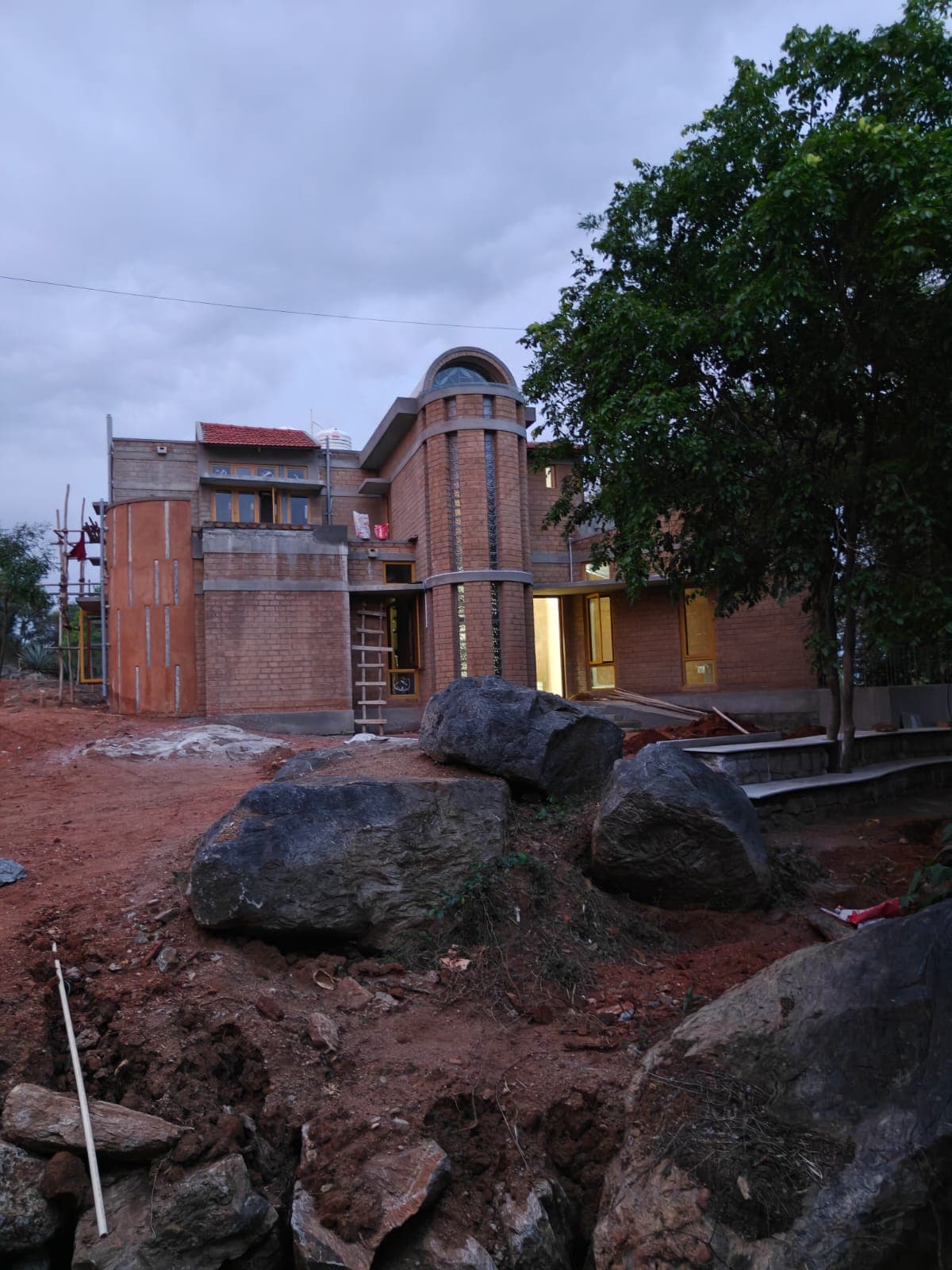
When the plot was still rock and scrub, the easy plan was obvious: level it, pour a slab, put up a concrete frame, fill the walls with cement block, paint it something cheerful. It is what most weekend homes around Hosur are. We did almost none of that.
Building around the boulders
The granite outcrops were the reason we bought the land. Blasting them would have given us a flatter site and a duller one. So the house was drawn around them — the front steps go past one, the lawn flows between two more, and the pool sits where the ground naturally falls away. Nothing was moved that could be left alone.
Walls that breathe
The walls are handcrafted brick, laid by masons from the villages around us, on stone plinths. Brick and earth walls are heavy, and that mass is the point: they take the day's heat slowly and give it back slowly, so the rooms stay cool through the afternoon and comfortable at night without the air-conditioning running all day. They also breathe. A brick house in the rains smells like rain, not like paint.
The tower
The curved tower on the front is the one thing people photograph first. Its vertical slit is made of glass blocks, and it lights the stairwell from sunrise to sunset without a single bulb. It also pulls warm air up and out — old logic, no moving parts.
What it cost us
Time, mostly. A house like this goes up at the speed of the people laying it, and a good mason will not be hurried. We lost a season to the monsoon. We would do it again. Every wall here holds a little quiet, and you feel it the moment you walk in.
We built this home the slow way — by hand, from the soil beneath our feet.